Obama said, among other things:
He also said,
[...]
Dedicated to the idea that thought and conversation is not enough; only through constant action can we maintain our humanity and fight for justice.
Activists looking to the Obama administration to repudiate Bush’s most draconian immigration policies may find little to cheer about so far under Homeland Security Secretary Janet Napolitano. A new policy directive from her office seems geared toward refining the status quo: an enforcement-heavy approach focused on securing borders rather than dealing with the social impacts of migration.
Though the plans are still emerging (a full departmental assessment of various immigration programs is due out later this month), Napolitano’s initial outline emphasizes immigration as a crime and law enforcement issue: programs to enlist local police in immigration crackdowns, efforts to facilitate the deportation of immigrants convicted of crimes, and targeted round-ups of “fugitive” immigrants.
The directive also calls for an assessment of immigrant detention facilities and the effectiveness of the heavily criticized “E-verify” system for work authorization.
Though these moves signal an effort to make immigration law enforcement more efficient and effective, Tom Barry at the Transborder Project of the Americas Policy Program cautions that the aim seems to be crystallize, not decisively break from, the harsh initiatives promoted by predecessor Michael Chertoff. Despite apparent resolve to evaluate and challenge the previous programs and practices, he writes:
"the new directive will certainly disappoint those hoping for a rejection of Chertoff’s law-and-order regimen for immigration by Napolitano and the Obama administration. Instead of rejecting the enforcement-only approach as inhumane, Napolitano seems intent on rationalizing and finessing the crackdown launched by her predecessor, while making improvements around the edges...."No questions or concerns about the multitude of issues and problems that resulted from the security-driven campaign to fortify the border and round up suspect immigrants – the value of the border wall, the central role of private prisons in immigrant detention, the wisdom of U.S. drug policy with respect to border drug-related violence, the decreased attention to political asylum and refugee policy, the consequences of workplace raids, etc.
"A professional bureaucrat and politician, Napolitano is busy organizing, systematizing, and improving the crackdown that Chertoff so zealously spearheaded."
Perhaps one should expect as much from a law-enforcement focused bureaucracy. But that's all the more reason to keep the pressure up for a wholesale restructuring of federal immigration policy via legislation.
RIVERHEAD, N.Y. — When Suffolk County prosecutors charged seven teenagers in the deadly assault on Marcelo Lucero, an Ecuadorean immigrant, in Patchogue, on Long Island, last November, one of the more disturbing accusations was that they engaged in a regular and violent pastime: hunting for Hispanics to attack.
On Wednesday, the prosecutors painted a newly detailed picture of what they said was a yearlong rampage by some of the teenagers, announcing new indictments that accuse the seven defendants in the fatal attack of assaulting or attempting to assault a total of eight other Latino men.
Prosecutors believe that many more teenagers — they are not sure how many — were involved in attacks on Hispanics in and around Patchogue, and are still at large. Investigators believe that there is a separate group of teenagers who roam Patchogue on bicycles attacking Latinos, according to a law enforcement official, who spoke on the condition of anonymity because the investigation is continuing.
“There is a lot of work still to be done,” District Attorney Thomas J. Spota said, “to ensure the safety of all the people who choose to call Suffolk County home.”
Five of the defendants — Christopher Overton, Anthony Hartford, Jose Pacheco, Jordan Dasch and Nicholas Hausch — pleaded not guilty in Suffolk County Criminal Court. The other two, Kevin Shea and Jeffrey Conroy, are expected to plead not guilty at arraignments next week. Not all of the defendants are charged in each case.
Jose Perez, a lawyer for LatinoJustice P.R.L.D.E.F., an advocacy group, said the new cases were “the tip of the iceberg” in a pattern of violence against Hispanics, and show that a more aggressive police response to earlier attacks could have prevented Mr. Lucero’s death.
After Mr. Lucero died, many other immigrants came forward to describe attacks. Some had never been reported; others were reported to police at the time, but no one was arrested, in part because language barriers made communication difficult, Mr. Spota said.
Investigators who were searching for new suspects showed more than 20 victims photographs of more than 20 of the defendants’ friends and acquaintances, but none were identified as assailants by any of the victims, the law enforcement official said.
In one of the new indictments, Mr. Pacheco and Mr. Conroy, who is accused of fatally stabbing Mr. Lucero on Nov. 8, were charged with beating Carlos Orellana on July 14, 2008.
Mr. Orellana was one of 11 Latino men who gave detailed accounts of 13 similar attacks to The New York Times for an article published this month. The cases reported in the article are now under investigation, a law enforcement official said.
On June 24, 2008, prosecutors said, a group of teenagers attacked Robert Zumba, kicked him and restrained his arms while Mr. Conroy lunged at him with a knife, cutting him.
Another man, Jose Hernandez, was attacked three times in a week in December 2007 by members of the group, prosecutors said. In one incident, they said, Mr. Conroy held a pipe in one hand and smacked it against his other palm, saying “We’re going to kill you.”
Lawyers for the defendants questioned how the victims could have identified their clients after so long, and suggested that prosecutors were pinning every possible assault on them.
Mr. Spota said prosecutors had considered the possibility that victims only thought they recognized the defendants because they had seen them in media coverage, and were careful to seek corroborating evidence.
The law enforcement official said that photo lineups were used to identify the suspects. In one case, Mr. Hartford, Mr. Hausch and Mr. Dasch are charged with attacking a man prosecutors identified as Petronila Fuentes Diaz on the night that Mr. Lucero was killed. A baseball cap that Mr. Diaz reported missing was found in Mr. Dasch’s car, the official said.
One of the challenges, the official said, was getting teenagers who may have known of the regular attacks to come forward. A few cooperated “reluctantly” with the investigation, recounting how some of the defendants bragged of certain attacks, the official said, but “they were resentful that their friends had been caught.”
Members of the Restaurant Opportunities Center New York accompanied by Judson Memorial’s Jeff Mansfield, traveled to DC for the march. For a film clip of the rally look here
| By Lucy Ash BBC World Service |
I first met Dr Izeldeen Abuelaish eight years ago when I made a radio documentary about his extraordinary life and work.
A Palestinian obstetrician who specialises in treating infertility, he lives in Jabaliya in the Gaza Strip, but used to work part-time in Israel helping Jewish women to have babies.
He also had a clinic in Gaza, taught medical school students there and arranged for seriously ill Palestinian patients to be treated in Israel.
He put up with the tedious and sometimes humiliating border checks with dignity and patience.
He stayed calm when one of his own Palestinian medical students told him she was "very, very angry" that he was helping Israelis to have children.
"What if these babies grow up to become soldiers who kill our people?" asked the young woman.
Despite all the suspicion, the hatred and the barriers Dr Abuelaish continued his work.
In 2001, Dr Gad Potashnik was in charge of the IVF clinic at the Soroka University Hospital in Beersheba.
He described Dr Abuelaish as a "magical, secret bridge between Israelis and Palestinians".
But that "magical, secret bridge" is now close to breaking point.
I have stayed in touch with Dr Abuelaish over the years.
Since we met he has had a number of jobs and research posts abroad.
In September 2008 he was about to start working for the European Union in Africa but had to return home after his wife, Nadia, fell ill with leukaemia.
Israeli patients
She died soon after his return, leaving him a widower with eight children aged three to 20.
In the middle of the recent conflict, I interviewed Dr Abuelaish for the BBC World Service's Outlook programme.
He told me all the glass had been blown out of the windows of his house, he could hear firing and explosions all around and he was desperately worried for the safety of his children.
Then on Friday afternoon, just a day before the ceasefire was announced, his worst nightmare came true.
"My daughters were just sitting quietly talking in their bedroom at home," Dr Izeldeen Abuelaish told me on the phone between sobs.
"I had just left the room, carrying my youngest son on my shoulders. Then a shell came through the wall.
"I rushed back to find their dead bodies - or rather parts of their bodies - strewn all over the room. One was still sitting in a chair but she had no legs.
"Tell me why did they have to die? Who gave the order to fire on my house?"
In a voice cracked with emotion, he added: "You know me, Lucy. You have been to my house, my hospital; you have seen my Israeli patients.
"I have tried so hard to bring people on both sides together and just look what I get in return."
The victims were Bisan, aged 20, Mayar, 15, Aya aged 13 and the physician's 17-year-old niece Nur Abuelaish.
"My eldest daughter was five months away from finishing her degree in business and financial management. She was looking forward to the future and I was so proud of her."
I remember talking to Dr Abuelaish in his house as his children scurried around him asking questions and singing songs.
Bisan was a cheeky, bright-eyed girl, keen to show off her English and read aloud from her school text book.
Audience response
During the recent military campaign, Dr Abuelaish, who speaks fluent Hebrew, had been acting as an unofficial correspondent for a Tel Aviv-based TV station, giving daily updates by phone.
He was determined to let Israelis know as much as possible about the suffering of Palestinian civilians under Israel's bombardment.
Minutes after the shell hit his house, Dr Abuelaish phoned the station's presenter, Shlomi Eldar, to describe what had happened.
The Israeli journalist looked awkward and visibly distressed as the doctor's disembodied voice is broadcast crying: "My daughters, they killed them, Oh Lord. God, God, God."
Mr Eldar mobilised his contacts in the Israel military to open the border and fly the injured girls by helicopter to the Tel Hashomer Medical Centre, the largest hospital in Israel.
He said thousands of viewers had called the station following the harrowing interview with Dr Abuelaish.
"I think this broadcast will change public opinion in Israel," said Mr Eldar speaking by phone from Tel Aviv.
"It feels to me as if some of our audience is seeing and hearing about the high price ordinary Palestinians are paying in this conflict for the first time".
Dr Abuelaish's 17-year-old daughter Shadha is recovering there from an operation which may save her right eye, injured in the blast.
Her 12-year-old cousin Daida is in a critical condition from shrapnel wounds.
A spokeswoman for the Israeli military said the incident is now under investigation.
"For the time being, all that I can tell you is that our troops fired on the house because they had come under attack from somewhere in the vicinity of the house. Possibly a sniper but I can't confirm that," the spokeswoman said.
Speaking from the hospital, Dr Abuelaish denied that any militants had been hiding in or firing from his house.
"Violence is never the right way. My daughters and I were armed with nothing but love and hope."
Freedom of expression is once again on the agenda in Denmark. The country received world attention when the rightist newspaper Jyllands-Posten published provocative cartoons of the Prophet Muhammad a few years ago. The cartoons caused widespread protests in the Muslim world, whereas discussions in Denmark and other Western countries revolved around freedom of the press.
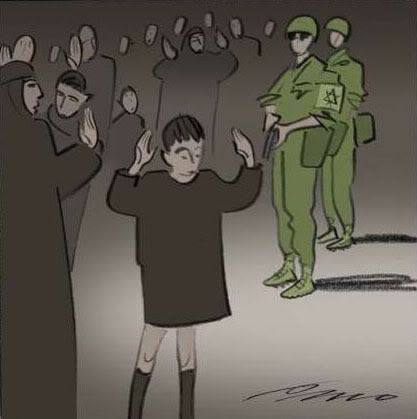
This time, a new cartoon controversy was set off by the liberal daily Politiken. The paper's cartoonist Per Marquard Otzen published a cartoon that depicts Israeli soldiers' behavior in the attack on the Gaza Ghetto by drawing upon a 1943 photograph of Nazi persecution of Jewish women and children in the Warsaw Ghetto.
In an open letter of protest to the editors of the paper, Finn Schwartz, a leader of the Jewish community, asked: "Does Politiken really think, as the cartoon implies, that the relation between Israel and Hamas is comparable to that between Hitler's Germany and European Jews?" The letter expressed pain and anger at the message of the cartoon: "For the Jewish community, especially for the Jews who survived the Holocaust, it is inconceivable to make such comparisons between the Israeli army's conduct and the Nazis' attempt at the final solution [Endlosung] of the Jewish people."
In his reply, Politiken editor-in-chief Toger Seidenfaden says that such a comparison is indeed inappropriate in his opinion and would never appear in an editorial of the paper. But he also makes it clear that he doesn't believe the cartoon to be so crude that it should not have been published at all. Nor does he regard a debatable and disproportionate historical comparison as equivalent to anti-Semitism. Furthermore, he points out the fact that most major newspapers in the world have in fact published similar comparisons.
It should be recalled that there has always been a strong pro-Israel public opinion in Denmark since the proclamation of the Jewish state. However, the war on Gaza has created a shift, which can be also observed within the political class. At a relatively large Copenhagen demonstration against Israel's war on January 13, all parties of the opposition (from the center left to the extreme left) had their leading members speak to the 6,000-7,000 people assembled at City Hall Square and in front of the Danish Parliament.
A similar evolution is visible elsewhere on the continent. There has been much unease in Europe about the scope of Israel's military response and the resulting civilian casualties. Event though the "politically correct" position is still that Israel, like any other country, has the right to defend itself, questions about proportions and consequences for civilians are giving rise to debates on the Israeli policy toward the occupied territories, which are in turn creating a new awareness of the Israel-Palestine problem. The mantle of Jewish victimhood, which has long served to cover Israel's occupation in Palestine and its attacks on its Arab neighbors, is in the process of being frayed by Israel's own warfare on a defenseless population.
Israel has lost carte blanche, and that is a positive development. On the other hand, there is also a negative development: there have been attacks on individual Jews and Jewish symbols in most European countries, raising fears of new anti-Semitism. The promise of Zionism that the creation of a Jewish state would bring safety and security to world Jewry has proven to be an illusion. The tragic irony of modern Jewish history is that anti-Semitism may become reinvigorated, or more accurately a new variety of it may grow, as a reaction against the Zionist project. An increasing number of Jews, especially in the diaspora, are aware of this danger. One of the questions raised by Israel's latest war is what form Jewish responses to Zionism, as well as to shifting public opinions about Israel, will take.